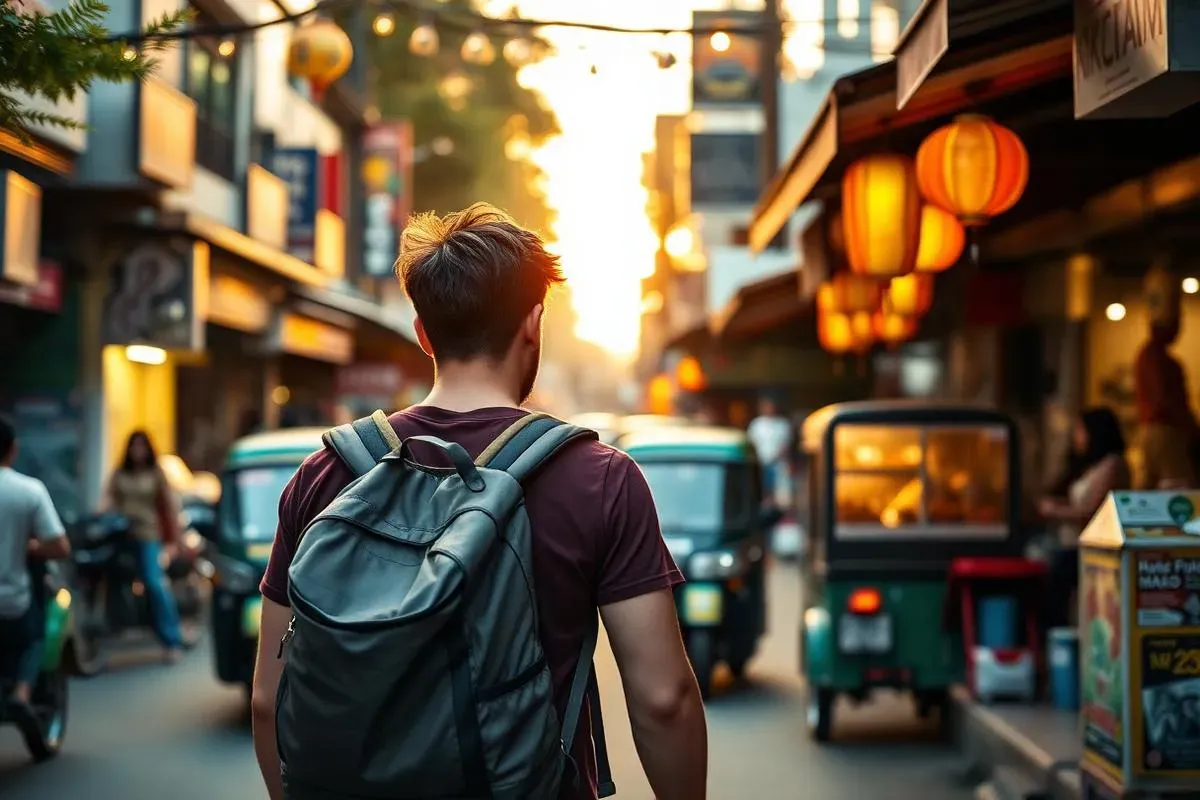
Backpacking Southeast Asia in 2026: the best stops on the Banana Pancake Trail from Bangkok to Hanoi, plus budgets, routes, seasons and practical first-timer tips.
Route map
The Banana Pancake Trail on the map
Click a stop on the map or in the list and jump straight to that destination's section.
Selected stop
1. Bangkok, Thailand
The classic starting point: cheap flights, Khao San Road and night buses everywhere.
There is a route nobody ever officially drew on a map, yet every backpacker finds it within a few days. It runs from the night-time streets of Bangkok to the temples of Cambodia, from the river towns of Laos up the Vietnamese coast — and along the way every second hostel breakfast menu offers a banana pancake. Hence the name: the Banana Pancake Trail. If you are planning your first long trip, backpacking Southeast Asia is still the easiest way in the world to start: cheap, safe, well travelled and full of people heading the same direction as you.
What exactly is the Banana Pancake Trail?
The Banana Pancake Trail is an informal backpacker route that has been forming since the 1970s, linking the cheapest and most popular stops in Thailand, Cambodia, Laos, Vietnam, Malaysia and Indonesia. Nobody maintains it — it lives on hostel noticeboards, in night-bus timetables and in wherever other travellers happen to be going.
In practice the route means three things: cheap accommodation (dorms 6–14 € a night), a ready-made transport network (night buses, trains and ferries built for exactly this crowd) and a very low barrier to meeting people. Anyone who leaves alone rarely travels alone for long.
The classic direction is Bangkok → Cambodia → Vietnam → Laos → back to northern Thailand, or south towards Malaysia and Indonesia. One month covers two countries comfortably; two months covers three or four.
1. Bangkok — the natural starting point
Almost every Southeast Asia backpacking trip starts in Bangkok, because flights there are the cheapest and because the city connects to everywhere. Khao San Road is still the legendary first street, but a calmer and more authentic base today is Phra Nakhon in the old town or the area around Ari station.
Book your first two nights in advance — jet lag and 30 °C humidity are a poor combination for hunting a bed. On day one, do only three things: withdraw cash, get local data and eat on the street. Wat Pho, Yaowarat Road in Chinatown and the river boat make the best first-day programme.
Prices: dorm 8–12 €, street meal 1.50–3 €, metro 0.50–1.50 €.
2. Cambodia — Angkor Wat and the southern islands
Siem Reap is a small, easy town whose only reason to exist is Angkor Wat, the largest religious complex in the world. The three-day pass (62 USD) beats the one-day option: the small circuit in the morning, the grand circuit on day two, and on day three the outer temples such as Beng Mealea, where there are no crowds.
Don't stop at the temples. Kampot and Kep in the south are slow river towns, and Koh Rong Sanloem is the island where many people stay longer than planned. In Phnom Penh, visit the Tuol Sleng museum — heavy, but it explains the country's recent history.
Tip: Cambodia runs on US dollars, and torn notes are refused. Check the notes when you withdraw cash.
3. Vietnam — north to south on a single line
Vietnam is the most varied country on the trail: Hanoi's old quarter, the karst cliffs of Ha Long or the quieter Lan Ha Bay, Hue, the lantern town of Hoi An, the beaches of Da Nang and the glorious chaos of Ho Chi Minh City. The country is usually travelled in one direction so you never repeat a leg.
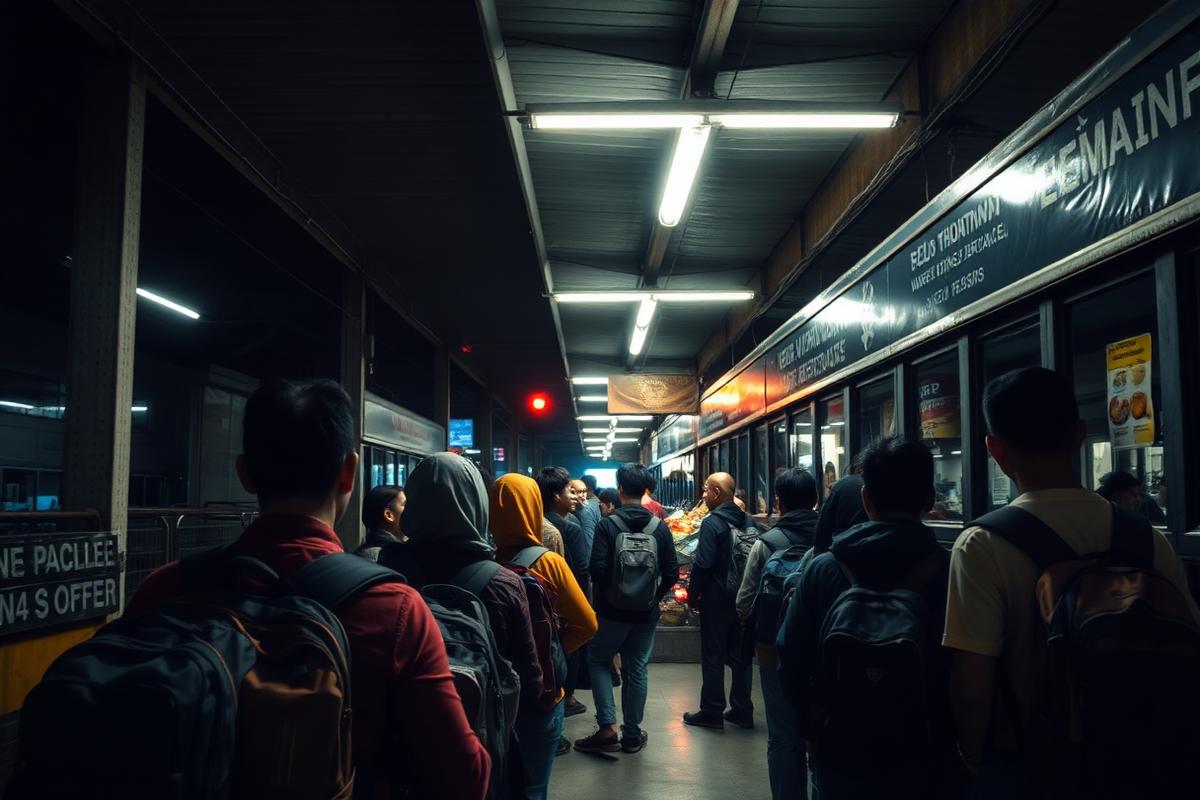
The single best experience is the Hai Van Pass between Hue and Da Nang — either by train along the coast or on the back of a local rider's motorbike (an easy rider, roughly 60–80 €, with your bags transported separately). In the north, the Ha Giang Loop is a three- to four-day mountain route that ends up being the highlight of many trips.
Tip: traffic in Vietnam does not stop for pedestrians. Cross at a steady pace without looking back — the scooters flow around you.
4. Laos — the slow boat and Luang Prabang
Laos is the calmest stretch of the trail. The classic is the two-day slow boat from Huay Xai to Luang Prabang along the Mekong, with an overnight stop in Pakbeng halfway. It is not the fastest way to move, but it is the reason to come to Laos.
Luang Prabang is a UNESCO World Heritage Site: temples, French baking traditions, the Kuang Si waterfalls and the morning alms-giving ceremony (watch from a distance and without flash). Vang Vieng is now more of a climbing, caving and hot-air-balloon destination than the old river party town, and Nong Khiaw is a northern mountain village without the crowds.
5. Southern Thai and Malaysian islands — the wind-down
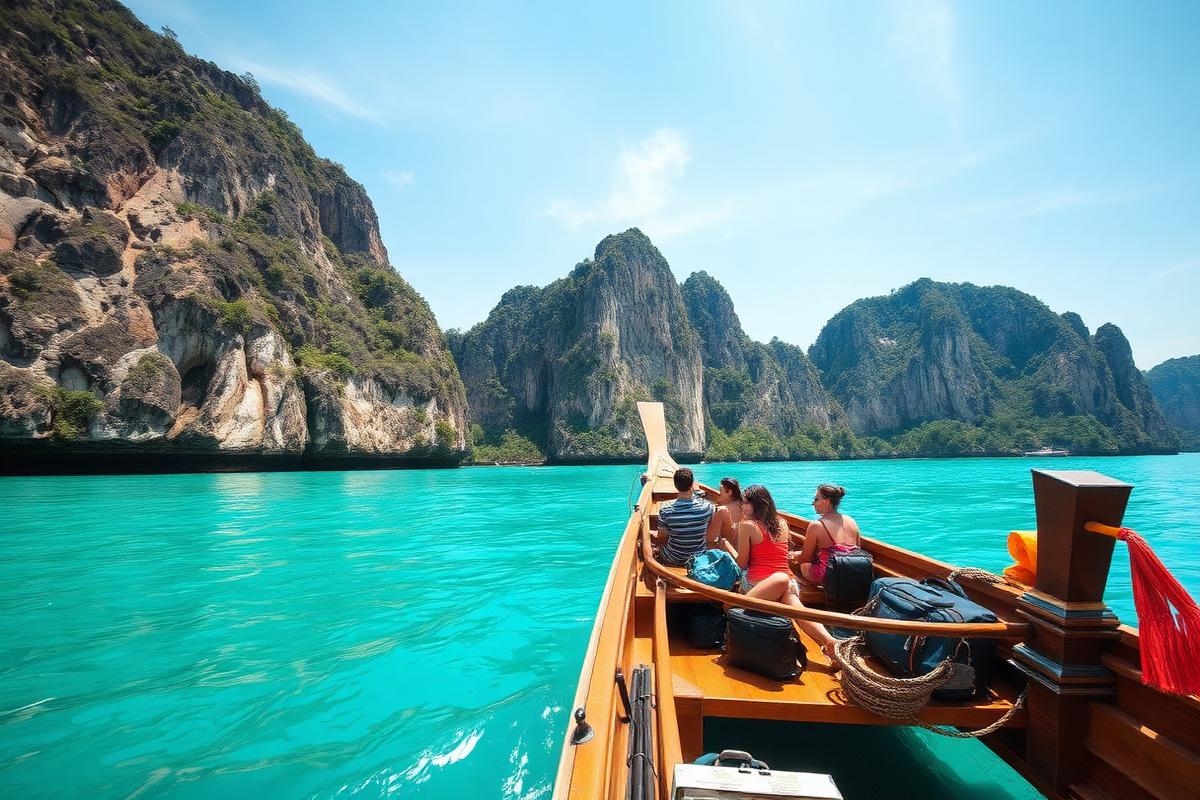
Many people save the islands for last. On the Andaman side Ko Lanta and Railay are calmer than Phuket; in the Gulf of Thailand, Koh Tao is one of the cheapest places on earth to learn to dive (Open Water around 300–350 €). Malaysia's Perhentians and Langkawi are the natural continuation if the trip carries on south towards Singapore and Indonesia.
Remember that Thailand's two coasts have opposite rainy seasons: when it pours on one side, the sun shines on the other. That is the single most useful weather rule on the whole route.
Budget and season
A realistic budget for backpacking Southeast Asia is 30–45 € a day if you sleep in dorms, eat mostly street food and travel by bus. 55–70 € a day buys private rooms, the occasional flight and diving or motorbike trips. Add flights from Europe at 550–850 € return, plus insurance.
Best season: November to March is the driest and most pleasant period across almost the whole region. April and May are the hottest, and June to October is the rainy season — the rain usually arrives as an afternoon downpour rather than ruining the day, and prices are clearly lower.
Compare flights to Bangkok on Kiwi.com and read the cheap flights 2026 guide before booking. For hostels and cheap private rooms, check Booking.com — on a long trip, book only 2–4 nights at a time so the route stays flexible.
The most important travel tips
- Pack a 40-litre backpack, no more. Anything missing is cheaper to buy on the road. Read the complete packing list.
- Get an eSIM before you leave. Data works the moment you land, with no SIM queues — Airalo and the eSIM guide.
- Take insurance that covers scooters and diving. These are the most common claims in the region — SafetyWing and the travel insurance comparison.
- Always pay in local currency. Decline the card terminal's euro offer — see Revolut vs Wise.
- Book night buses through your hostel or a booking platform a day ahead, not in a rush at a street counter.
- Drink only bottled or filtered water and eat at stalls with a queue and fast turnover — health on the road.
- Don't over-plan. Lock in the first week only; the rest of the route comes from people you meet.
- Respect temple dress codes: shoulders and knees covered, shoes off inside.
FAQ — backpacking Southeast Asia
How long should the trip be? Three weeks minimum for one or two countries. One to three months is where the route really starts to work.
Is the region safe for solo travellers? Yes, it is one of the safest backpacking regions in the world. The most common problems are scooter accidents, petty theft and stomach bugs. See also the female solo traveller's safety guide.
Do I need visas? With an EU passport, Thailand, Malaysia and Indonesia allow short stays without a pre-arranged visa, Cambodia and Laos issue visas on arrival or online, and Vietnam requires an e-visa in advance. Always check current rules before departure.
Is English enough? Yes, along the entire route. A few words of the local language still opens doors.
Best country to start in? Thailand. The infrastructure is the best, prices are low and it is easy to continue in any direction.