Written by Matkustelu.fi
Updated 3.11.2026
Some links in this section are affiliate links. We may earn a commission if you book through them, at no extra cost to you.
Pack only what you need: a universal packing list that works for every trip, plus rolling techniques, cabin bag rules and what to leave at home.
Packing checklist: the essentials first
Documents and money: passport or ID where accepted, travel documents, payment card and a backup payment method. Carry-on: essential medication, chargers, a power bank packed according to airline rules and valuables. Clothes: versatile layers for the expected weather and available laundry facilities. The day before departure: check the forecast, document validity and your airline's cabin baggage allowance. See the carry-on size guide.
Efficient packing is a skill that every traveller can learn. The key is to minimise items and maximise usability. A good rule of thumb: if you didn't use it on your last trip, leave it at home. Minimalist packing reduces stress, speeds up travel and saves money on checked baggage fees. This packing list works equally well as a base for a week at the beach, a city weekend or a month of backpacking — you add destination-specific items from the checklist near the end.
The packing list at a glance — print it or save it
| Group | Baseline for one week | Notes |
|---|---|---|
| Tops | 3–4 | Merino or technical fabrics, neutral colours |
| Bottoms | 2 | One pair of trousers, one pair of shorts or a skirt |
| Underwear and socks | 5 pairs | Quick-drying, wash on the road |
| Outer layer | 1 jacket | Windproof and water-resistant shell |
| Shoes | 2 pairs | Walking shoes on your feet, light pair in the bag |
| Toiletries | 1 pouch | 100 ml/container; check airport rules |
| Electronics | 1 kit | Phone, charger, power bank, adapter |
| Documents | 1 folder | Passport, insurance, backup card, copies |
| Medication | 1 pouch | Prescriptions in original packaging |
You can build your own version of this list with our packing list tool, which suggests items based on the type and length of your trip.
Clothes: a capsule wardrobe saves the most space
Choose multi-functional clothes in neutral colours that are easy to mix and match. Merino wool tops are excellent as they are breathable, odour-resistant and dry quickly — you can wear the same shirt two or three days. Use the capsule wardrobe principle: 3–4 tops, 2 bottoms, 1 jacket and comfortable walking shoes. When every top works with every bottom, five garments produce ten different outfits.
Layering replaces bulky single items. A thin base layer, a fleece or wool sweater and a windproof shell handle spring, autumn and even mild winter in Europe. One dark dress or collared shirt is enough for restaurants and temple visits where shoulders and knees must be covered. The shoe rule is simple: wear the heaviest pair on the flight and pack the light pair.
Packing techniques that genuinely save space
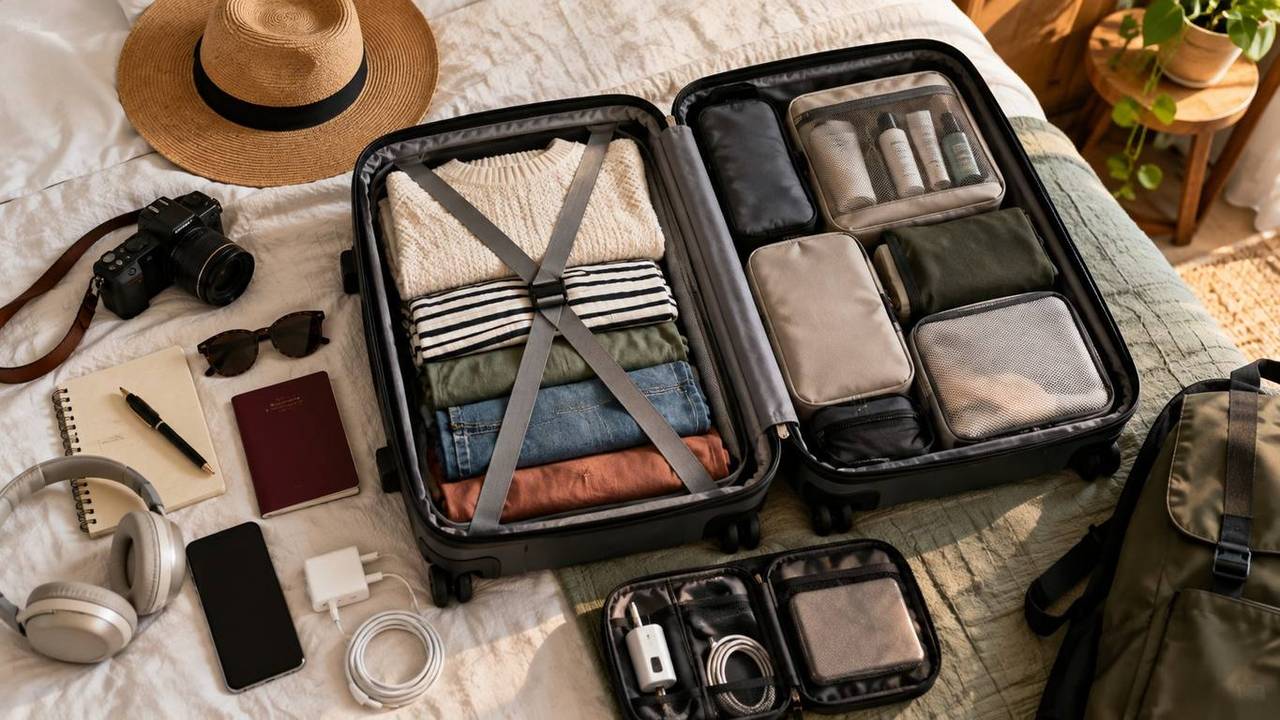
Roll soft clothes instead of folding them — you save space and avoid creases. Stiff shirts and blazers are better folded. Pack the heaviest items at the bottom of the bag, over the wheels, so it doesn't tip when you pull it. Fill the inside of your shoes with socks and chargers, and use shoe bags to keep soles off clothes.
Packing cubes don't create extra space, but they keep the bag organised and make packing light easy: one cube for tops, one for bottoms, one for underwear. A set of three costs 15–25 euros and lasts for years. Leave vacuum bags at home if you travel carry-on only — they reduce volume but not weight, and the weight limit is usually what stops you first.
Pack liquids upright and close lids carefully. Solid shampoo bars and genuinely solid toiletries can help meet liquid restrictions. Creams, gels and sunscreen lotions still count as liquids.
Electronics and chargers
Keep a phone, charger and power bank handy. Pack power banks in cabin baggage, never checked baggage. Under Finland's 2026 aviation guidance, you may carry at most two power banks, each rated at no more than 100 Wh. Do not use them to charge devices or recharge them during the flight. Check your airline's instructions and the Wh rating. A multi-port USB charger reduces the need for separate chargers.
A universal travel adapter matters outside your home region: the UK, Ireland and many Asian countries use different plugs. Consider an e-reader instead of books — one 250-gram device replaces 3–5 paperbacks. Wireless noise-cancelling headphones transform a long flight, and mobile data is best sorted before departure with an eSIM: Airalo(Affiliate link) works the moment you land, with no SIM queues. On public networks, payments and email are safer through Surfshark VPN(Affiliate link).
Toiletries and a travel first-aid kit
Pack only travel-sized products (under 100 ml for flights) or buy them at your destination. An all-purpose soap works for showering, laundry and hand washing. A toothbrush, deodorant and skincare are enough — hotels often provide shampoo and conditioner. A microfibre towel dries within an hour and takes a third of the space of a normal towel.
A travel first-aid kit holds painkillers, an anti-diarrhoeal, electrolyte powder, plasters, blister plasters, antiseptic gel and your own prescriptions in original packaging with a copy of the prescription. SPF 50+ sunscreen and insect repellent are as important as your passport in tropical destinations. There is more advice in our health on the road guide.
Documents, money and safety
Keep your passport, insurance card and copies of key documents both in cloud storage and on paper, stored separately from the originals. Check passport validity: many countries require at least six months remaining, and anyone travelling into or out of the EU should read the passport, ETIAS and visa guide.
Download offline maps before you leave and keep some cash and a backup card separate from your main funds. Two cards on different networks (Visa and Mastercard) save the trip if one fails or is swallowed by an ATM. Minimise currency fees — compare the options in Revolut vs Wise and estimate your trip budget with the travel cost calculator. Insurance is the one thing never to leave behind: see the travel insurance comparison.
Carry-on: pack for the first 24 hours
Keep all valuables, one change of clothes, toiletries and medication with you on the flight. If the checked bag is delayed, you manage a couple of days without shopping. Also pack an empty water bottle — you can fill it after security — plus snacks and entertainment for long flights.
Low-cost carriers typically allow a larger cabin bag of 55×40×20 cm and 10 kg, while network airlines often cap weight at 8 kg. A small bag that fits under the seat is usually free. Check exact dimensions in the carry-on size guide and choose your bag with the suitcase guide — the empty bag itself easily eats two kilos of your allowance.
Destination-specific extras
Beach trip: two swimsuits, a sarong, flip-flops, a waterproof phone pouch, a snorkel for longer stays and high-factor sunscreen. City break: proper walking shoes, a slim shoulder bag with front pockets, one smarter outfit and a light rain jacket. Winter and northern lights: merino base layer, fleece, shell, wool socks, a scarf, mittens and grips for your shoes — phone batteries fade in the cold, so keep the power bank in an inside pocket. Backpacking: a 40–55 litre pack, a padlock, a hostel sheet, earplugs, an eye mask and detergent in a small bottle. If you're heading to Southeast Asia, read our backpacking guide too.
What to leave at home
Too many "just in case" clothes, valuable jewellery, large books, multiple pairs of shoes, full-sized toiletries and unnecessary gadgets. An iron, a hairdryer and three novels are all available at the hotel or a shop on arrival, and the same goes for basic medicine, sunscreen and toothpaste in most destinations. If you hesitate, leave it out — the rule of thumb is that anything you haven't touched in three days at home isn't essential on the road.
Final travel checklist before departure
Make the packing list well in advance and check the weather at your destination a couple of days before you leave. Weigh the bag at home on a bathroom scale and leave 1–2 kilos of room for souvenirs. Photograph the packed contents: it speeds up a claim if the bag goes missing. Finally check passport, cards, medication and chargers — the four items most often left behind. Put the jackets and shoes you need first on top of the bag at night, so you pack them last.
Read next
Check your airline's limits in the carry-on size guide, sort connectivity with the eSIM guide, download the tools in best travel apps 2026 and pick cover with the travel insurance comparison. Heading somewhere warm? Start with the cheapest destinations 2026.
Written by Matkustelu.fi
Published 25.2.2026 Updated 3.11.2026
The Matkustelu.fi editorial team curates travel information and planning tips. Always verify changing rules, prices and timetables with the original sources.